
Saint-Gilles Church: a sanctuary in the heart of Kirchberg Saint-Pierre-Bois – Hohwarth
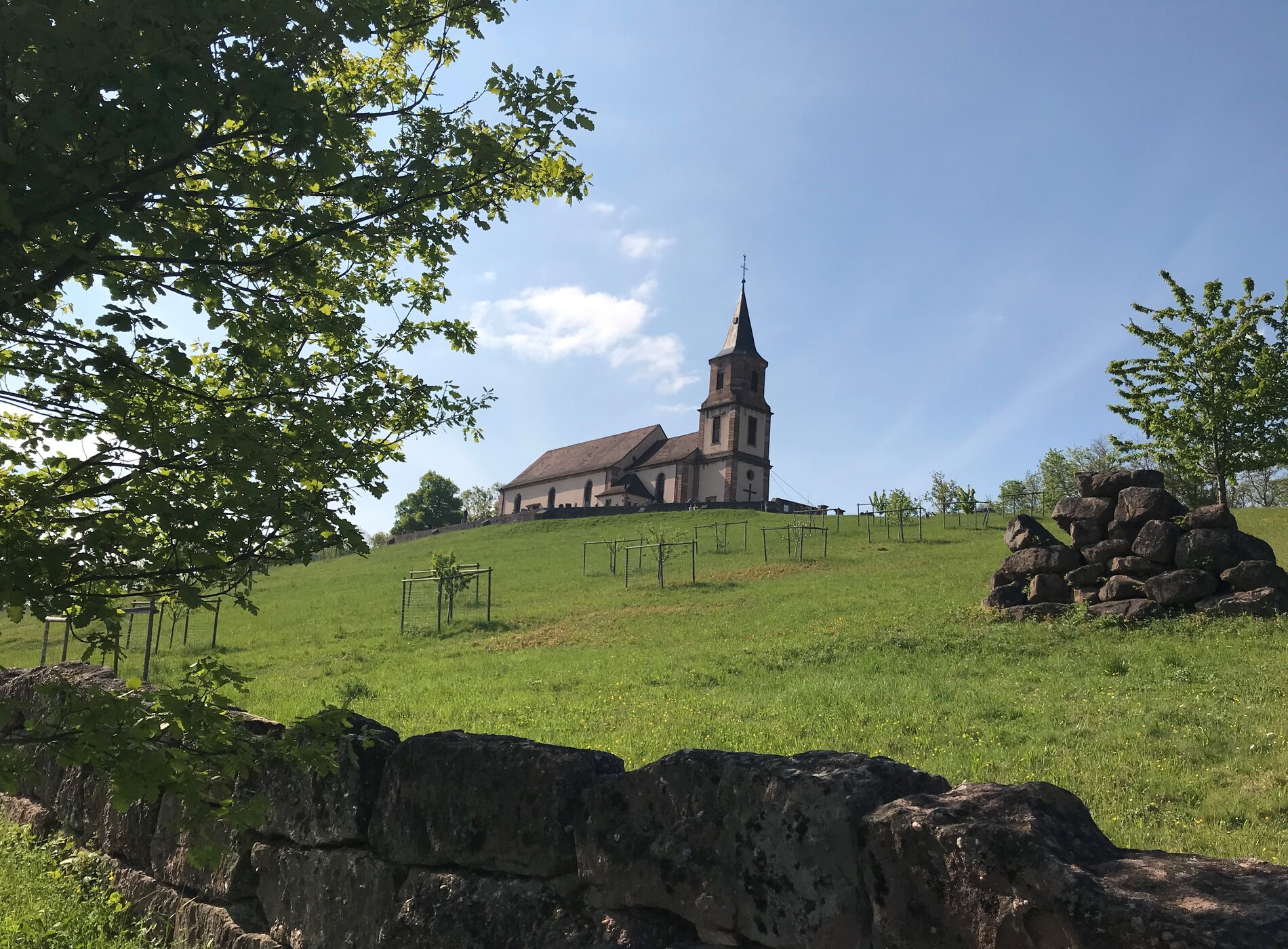
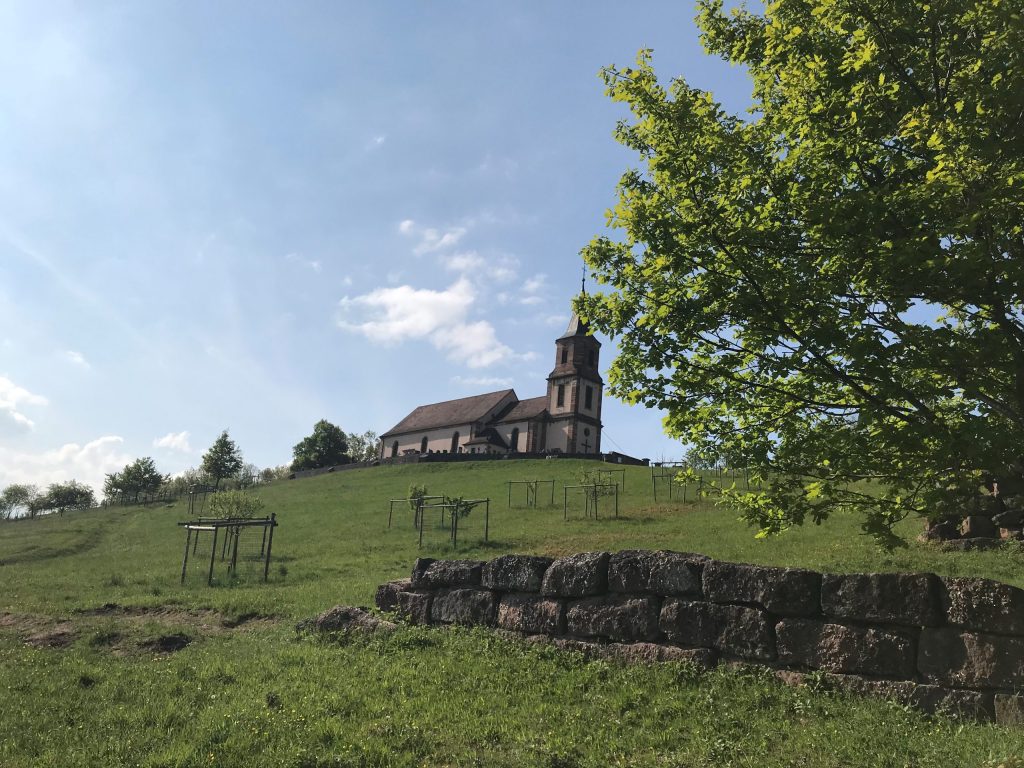
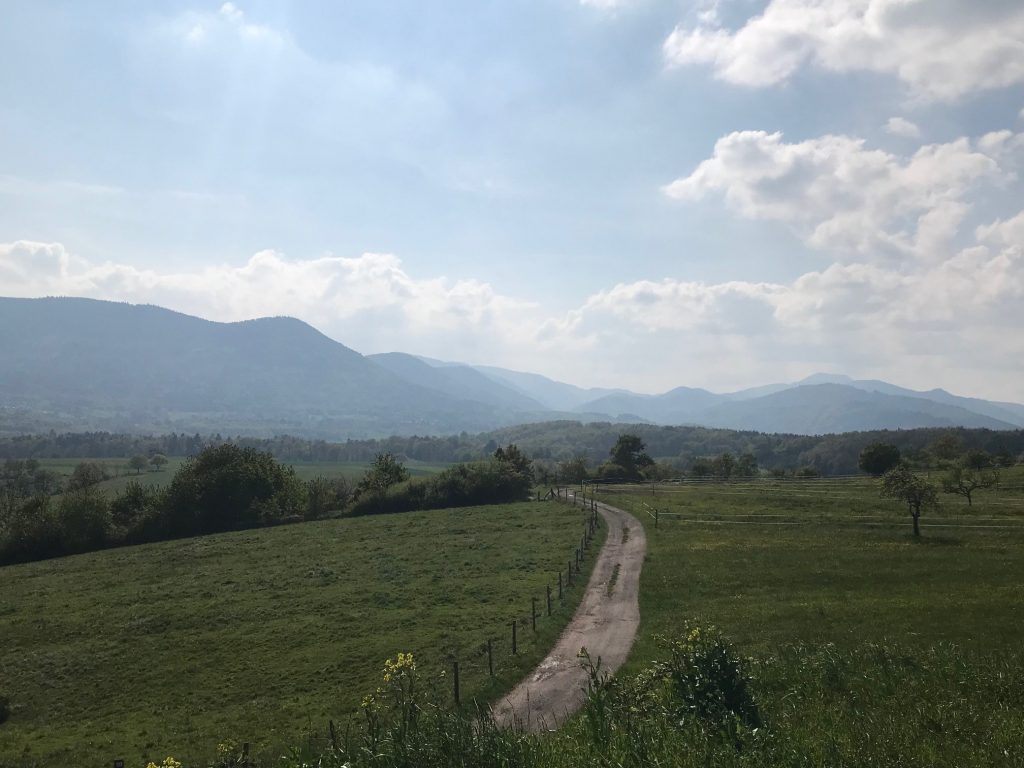
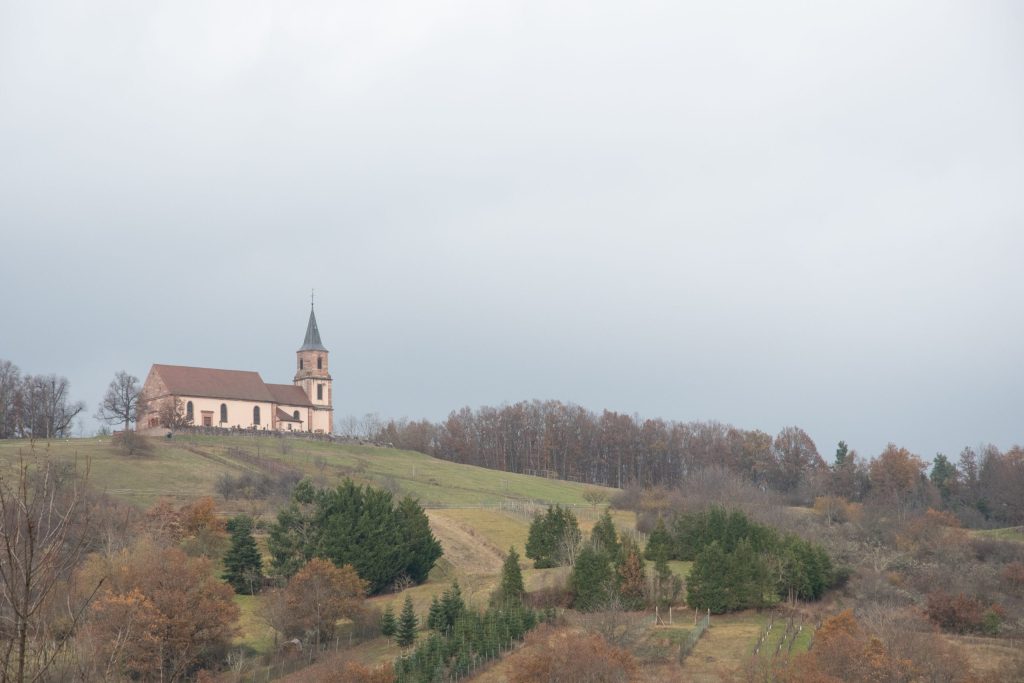
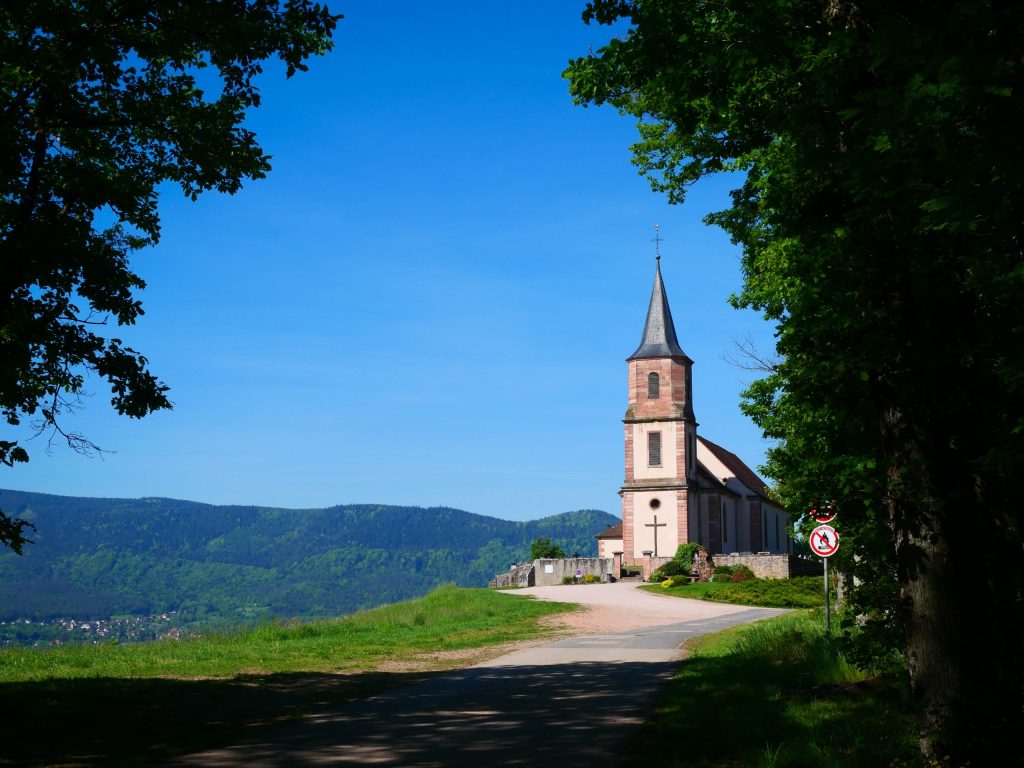
Perched on its promontory, at the summit of Kirchberg at 380 meters altitude, the parish church of Saint-Pierre-Bois and Hohwarth can be seen from afar when entering the Villé Valley.
Since the Middle Ages, this sanctuary has attracted pilgrims from near and far to venerate Saint Giles, one of the Fourteen Holy Helpers, traditionally invoked for their power of intercession.
Over the centuries, the church has undergone several transformations. Even today, it retains numerous testimonies of its history: works of art, stained glass windows, reliquaries, statues and paintings tell the long history of this place of worship and pilgrimage.
Saint Giles, the hermit who became patron saint
The Latin name for Saint Giles is Aegidius, which gave rise to the French name Gilles. The form of this name, of Greek origin, has led some traditions to attribute to him an Athenian birth and a royal lineage.
According to tradition, Giles was born in Athens before leaving his hometown to lead a hermit's life. His reputation for holiness and the many miracles attributed to him attracted numerous companions. His hermitage then gradually transformed into a monastic community, and later into an abbey.
Although he was a hermit and then a monk, Saint Giles is also presented as a great traveler. Tradition places his departure from Greece between the 6th and 7th centuries. He is said to have landed in Marseille before reaching the region of the Rhône estuary, where he founded the Abbey of Saint-Gilles-du-Gard.
It was in the crypt of the church of Saint-Gilles-du-Gard that his tomb was rediscovered in 1865.
The Legend of the Doe
Saint Giles is generally depicted as a monk, accompanied by a doe. According to legend, he took in and tamed this animal, which he protected during a hunt.
As hunters pursued the doe, Saint Giles intervened to protect her. He was then struck by an arrow in the hand. This episode has become one of the saint's principal attributes in Christian iconography.
Several miracles are also attributed to him. Tradition recounts that, when he was still a child, Gilles encountered a sick man lying on the ground. He covered him with his cloak, and the man was healed. On another occasion, he is said to have met a man bitten by a snake and healed him through prayer.
Kirchberg, a hill steeped in history
Kirchberg rises to an altitude of 380 meters and overlooks the villages of Saint-Pierre-Bois to the south and Hohwarth to the west.
The name Hohwarth, meaning "high lookout," once led some historians to suggest that a watchtower might have stood on this hill. The locality is documented as early as 1328 under the name Villa Hohenwart.
As its name suggests, Kirchberg is first and foremost the "church mountain". The sanctuary located there has been documented since the 13th century.
The presence of a church on this summit could be explained, in particular, by its central location between Saint-Pierre-Bois, Hohwarth, and several villages that have since disappeared. The proximity of a Cistercian grange belonging to Baumgarten Abbey in Reichsfeld would also have contributed to the site's importance.
The first church in Kirchberg
The chronicle of Father Jean-André Kramer, who served the parish of Saint-Pierre-Bois from 1839 to 1850, provides valuable information on the history of the church that has dominated Kirchberg for several centuries.
The first chapel gradually became too small to accommodate the many pilgrims attracted by the cult of Saint Giles.
A legend tells that it was then decided to build a new sanctuary on a lower site, to spare the parishioners the climb up the hill. But, despite the work undertaken and the materials brought in daily, these were mysteriously moved during the night to the site of the old chapel.
After several attempts, the inhabitants finally gave up on moving the construction site and built the new church in the place where, according to tradition, Saint Giles wanted it: at the top of Kirchberg.
Saint-Gilles Church today
The reconstruction of the Kirchberg church was far from simple. Legal and political complications delayed the project for more than twenty years. However, the patience and tenacity of the builders eventually allowed the project to be completed.
Construction of the nave of the current church began in 1788. For more than two decades, it remained attached to the remains of the old building, which had become very dilapidated. The tithe-collecting priest refused to finance the reconstruction of the chancel and bell tower, which was his responsibility.
The Concordat finally allowed the work to continue. The choir was built at the expense of the municipality in 1812, then the bell tower was erected in 1818.
Inside, the nave is arranged around four rows of pews, and five columns support the gallery. The organ, built in 1822 by J. Chaxel, was converted to pneumatic action in 1907 by M. and J. Rinckenbach, then modified in 1964 by C. Schwenkedel. It was restored in 2021 by H. Brayé.
Throughout the 19th century, the new church dominated a Kirchberg that was then largely covered with vineyards.
Since 2015, four bells have once again been marking the rhythm of life in the sanctuary.
To be discovered in the nave
The interior of the church retains many remarkable features.
The confessionals and the pulpit have notably been preserved. On the two panels of the pulpit are depicted Saint Peter and Saint Paul, while the sounding board is surmounted by a representation of Saint John the Baptist.
The two side altars are dedicated to the Virgin Mary and Saint Sophia. On the north altar, the angel Gabriel announces the birth of Christ to Mary. On the south altar, Saint Sophia, a Roman virgin and martyr, is depicted.
The ceiling painting, created in 1932 by René Kuder, an artist from Villé, depicts the "Triumph of Saint Giles." The saint looks towards the faithful who are imploring him.
A niche located to the south houses a remarkable polychrome wooden Virgin and Child. To the north is a statue of Saint Francis of Assisi, depicted with his right hand placed on his heart and bearing the stigmata, thus recalling his message of love and brotherhood.
A glass-fronted wall cabinet also contains a statue of Saint Giles dating from the 16th century as well as a votive offering from 1835.
Finally, a fragment of the old, very colorful decoration that once adorned the triumphal arch is still preserved on the choir side.
The stained glass windows of the church
The six windows of the nave are adorned with 19th-century stained glass, four of which depict saints. These works were created by the Höner workshops in Nancy.
Starting from the northeast side, we successively discover Saint Odile, holding in her left hand the book on which two eyes are depicted, then Saint Sebastian, represented pierced by arrows.
On the other side, we find Saint Arbogast, the first bishop of Strasbourg and second patron saint of the diocese, depicted as a bishop in a red chasuble. Beside him is Saint Francis Xavier, shown baptizing an Indian.
The stained glass windows on the side of the gallery, however, only feature geometric ornaments.
The choir and its altarpiece
The choir is accessed through the large triumphal arch, decorated with carefully executed stencil paintings.
Along the walls with rounded corners are modern stalls. This space was once reserved for the veneration of relics kept in the sanctuary.
Above the high altar is an altarpiece depicting the famous scene of the hunt of Saint Giles. It features the king of the Goths on a white horse, Saint Giles represented as a monk protecting his doe, as well as an archer and two dogs.
Two stained-glass windows illuminate the choir. They depict the Adoration of the Shepherds in Bethlehem and the Holy Eucharist.
On the ceiling, a painting depicts the Mystic Lamb.
The cult of Saint Giles
The cult of Saint Giles occupies an important place in the history of the sanctuary.
The reliquaries are now kept in a safe. These two pieces, a bust and an arm, date from the 14th century. They contain relics of several saints, including Saint Giles, Saint Sebastian, and Saint Agnes.
At the beginning of the 19th century, the pilgrimage attracted between 7,000 and 8,000 pilgrims each year. Such an influx even forced the celebrants, on September 1st, to preach under the oak trees in order to accommodate the many faithful.
Saint Giles is traditionally invoked to relieve deafness and headaches.
Today, the pilgrimage has retained some of its importance. Every year, the patron saint's festival still brings together more than 500 faithful in the sanctuary.
Perched atop Kirchberg, the Church of Saint-Gilles remains a unique place in the Villé Valley. A blend of history, religious heritage, legends, and works of art, it bears witness to centuries of devotion and continues to keep alive the memory of a sanctuary deeply connected to the villages of Saint-Pierre-Bois and Hohwarth.