Albe
Like many villages in the Villé Valley, Albé takes its name from the stream that runs through it: the Alder Stream. In German, the village was called Erlenbach, and in Alsatian, Erelbach. The word Erle refers to the alder tree, while Bach means stream.
The first mentions of Albé date back to 1303 in the form Erlenbach. This name evolved over time: Erlibach in 1362, Ehrlinbach also in 1362, before reverting to Erlenbach until 1665. After the First World War and the return of Alsace to France in 1919, the current spelling, Albé, became established. This Frenchification resulted from the natural evolution of the local Romance dialect, where Erle became Al and Bach transformed into Be.
The inhabitants and their nicknames
The inhabitants of Albé are quaintly nicknamed Kensterlegücker (those who look in the cupboard) or Fanschterlegücker (those who spy through the small window).
Bassenberg
The first mentions of Bassemberg date back to 1361 as Bassenberg, then to the 18th century as its current name. In the Alsatian dialect, it is called Bassebarri. The etymology of the name may derive from an old Germanic name, Badubald, meaning "the brave one in battle." Over time, this name was shortened into various forms such as Bado, Bezo, Basso, or Besso, which can be found in many village names in the region, such as Batzendorf or Bennwihr, the latter being a hamlet of Bado.
In the case of Bassemberg, the name could be translated as "Basso's mountain" (am Berg des Basso), referring to the village's location near a mountain. Another interpretation suggests that the name could derive from the Germanic root *der Basse*, meaning wild boar. The village would then mean "wild boar mountain," thus explaining the name Bassenberg or Bassemberg.
The inhabitants and their nicknames
The inhabitants of Bassemberg are nicknamed d'Krabbe (the crows).
latitude
The village of Breitenau, called Breitnau in Alsatian and Bratenau in the Romance dialect, is first mentioned in 1336 as Breitenow, then in 1359 as Breytenowe. It is likely that this toponym refers to the area's geography, characterized by a vast meadow (breit meaning "wide" and Aue meaning meadow in German). Contrary to some 19th-century theories, the Celtic origins of the name are now largely dismissed.
Name of the inhabitants
d'Guggug (the cuckoos)
Breitenbach
Breitenbach is mentioned in different forms over the centuries. In 1137, the village is referenced as Breiderbach, then Breitembach in 1303, Brechtembach in 1601, Breittenbach in 1665, and Berchbach in the 18th century before taking its current form, Breitenbach, in the 19th century.
The simplest and most popular interpretation of its name refers to a "wide river" (breit meaning wide and Bach meaning stream in German). The Breitenbach stream, which drains part of the waters of the Champ du Feu massif, is indeed substantial enough to justify this name.
Some older interpretations, particularly those suggesting Celtic origins, are no longer accepted by historians today.
The inhabitants and their nickname
The inhabitants of Breitenbach are nicknamed Beilarschretscher, which means "those who slip off the Pelage".
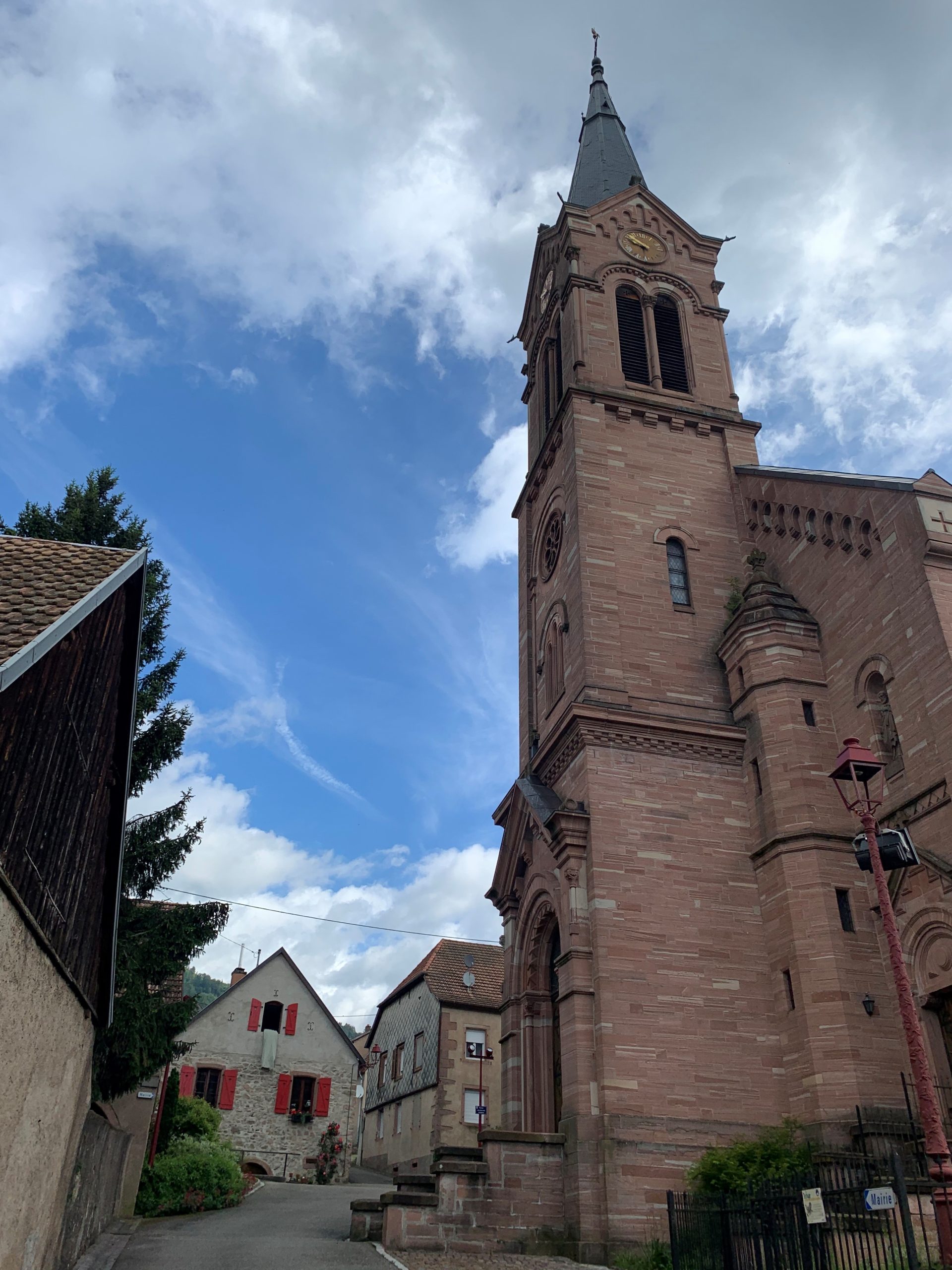
Dieffenbach-au-Val
In Alsatian, the village is called Dieffabach, and its spelling has remained virtually unchanged over the centuries. The name Dieffenbach appears for the first time in 1336, then again in 1359 and in 1690 as Tifenbas. It was only later that "au-Val" was added to distinguish this village from Dieffenbach-lès-Woerth. The name Dieffenbach is a Germanic toponym, supplemented by the French phrase "au-Val."
The popular interpretation of the name, "deep river" (tief meaning "deep" and Bach meaning "stream" in German), seems ill-suited to the village's geographical location. Indeed, Dieffenbach-au-Val lies in a gently sloping fore-valley, and its stream is anything but deep. It is shallow and often almost dry in summer, which makes this explanation unconvincing.
The inhabitants and their nickname
The inhabitants of Dieffenbach-au-Val are nicknamed Katzastecher, or "cat killers".
Fouchy
Fouchy, called Grube in German, Grüeb in Alsatian, and Fosche in the Welsche dialect, has a history marked by linguistic and cultural transformations. The village is originally mentioned as Groba in a charter from the early 13th century, although some analyses of these documents suggest they may be forgeries. The current name Fouchy is more recent, dating from the 17th century, a period when Alsace became French after the Thirty Years' War.
In order to restore the devastated region, Louis XIV encouraged the return of the former inhabitants, who had fled elsewhere, in 1662. He also invited French and foreign Catholics to settle in Alsace to cultivate and develop the abandoned lands. Among these new settlers were families such as the Humberts, from Lorraine, and the Brunettes, originally from Switzerland. It was probably around this time that the name Grube, still in use in the mid-16th century, was Gallicized to Fouchy. However, it is possible that this Gallicization had already begun partially in the 15th century. A document from 1688 mentions a certain P. Auger, "pastor in Fouchy" (pastor in Fouchy).
The name Fouchy could come from the local dialect word Fosche, a term still used in the 19th century to designate a "ditch".
Some historians suggest that Fouchy derives from an old name, Fossa, mentioned in a 12th-century document. However, it is more likely that this document refers to another village, La Grande Fosse, near Saales.
The inhabitants and their nickname
The inhabitants of Fouchy are nicknamed Fouchotte in the Welsche dialect, which means "fork".
Live
Lalaye, called Lach in German and Alsatian dialect, or Lela in the local Romance dialect, derives its name from a term meaning "puddle," "small pond," or "pond." This etymology accurately reflects the area's geography, as the valley is indeed damp and watered by several streams. The Mittelscheer River flows through the bottom of this valley before emptying into the nearby Giessen d'Urbeis.
The inhabitants and their nicknames
The inhabitants of Lalaye are nicknamed the "migeux de là", or "the bacon eaters".
Charbes
The hamlet of Charbes, formerly known as Mittelscheer, is mentioned in documents as early as 1471, then again in 1477, 1488, and 1492, notably in a charter concerning the Bilstein mines. Mittelscheer is the name of the stream that flows down from Climont and runs through a valley parallel to the Scheer d'Urbeis and the Steige valleys. Today, the Scheer is known as the Giessen. As for the toponym Charbes, it seems to derive from Scheer (which became "Char") and be (meaning stream), thus signifying "the stream of the Scheer."
The inhabitants and their nicknames
The inhabitants of Charbes are called the Horbotteux.