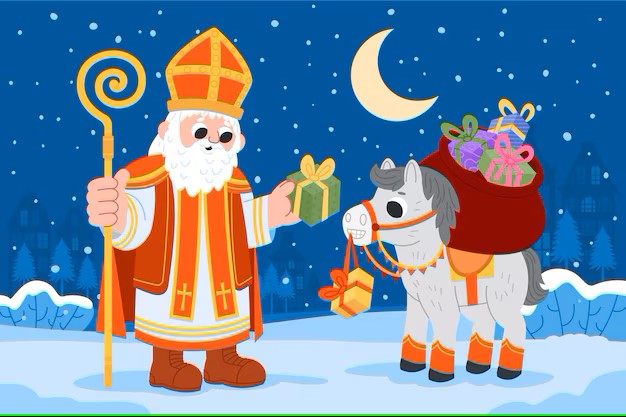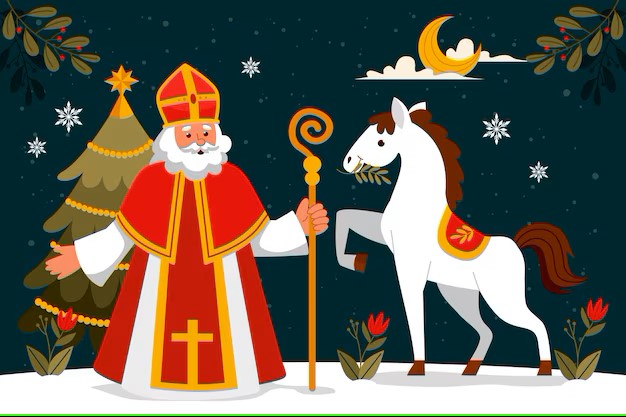
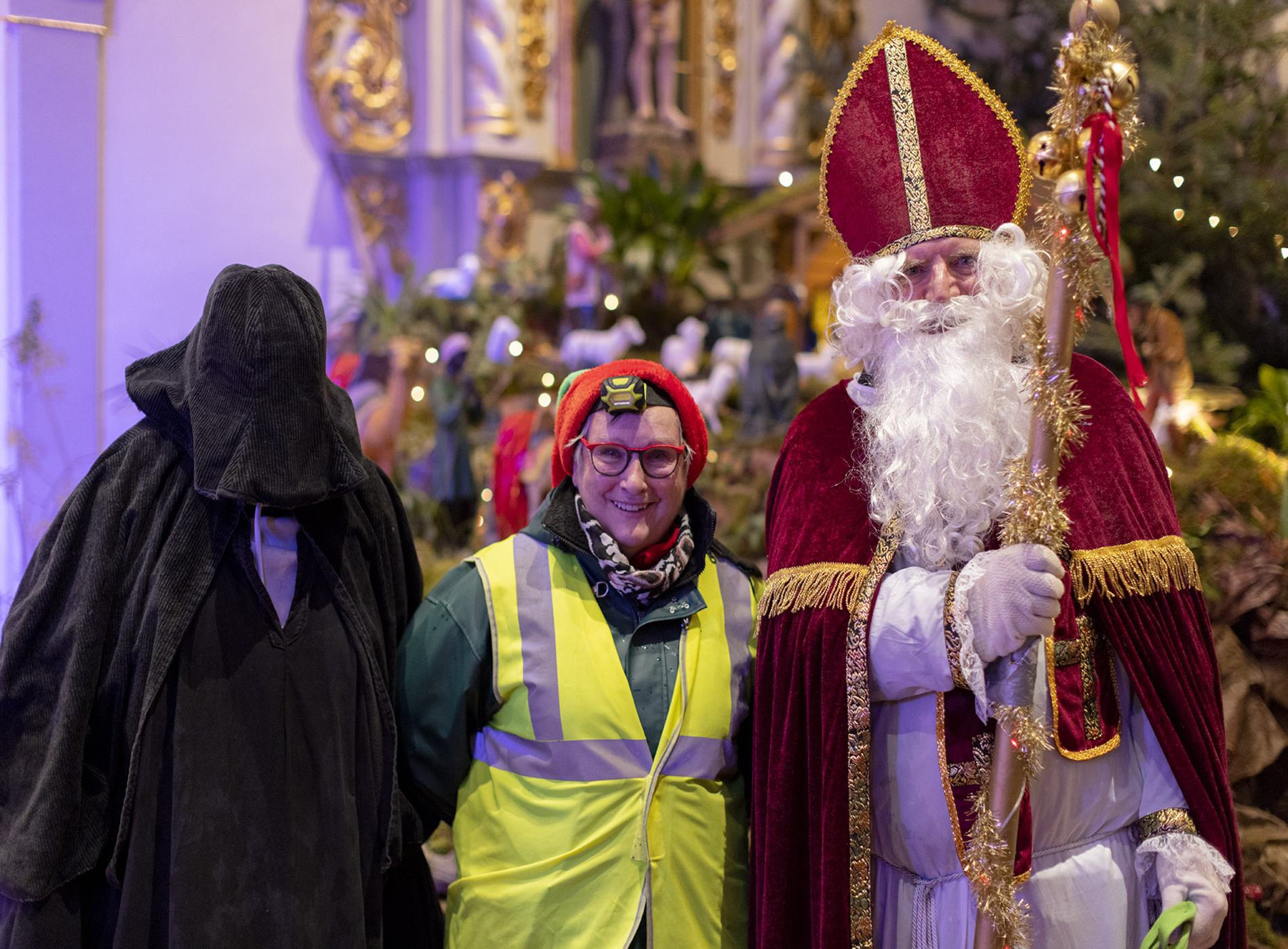
The Feast of Saint Nicholas takes place every year on December 6th. Saint Nicholas, the iconic bishop, is recognizable by his long white robe, his colorful cloak—often red, but sometimes purple, green, or blue—and the mitre adorning his head. He holds a crosier with a spiral tip.
Accompanied by his faithful donkey, often laden with gifts, Saint Nicholas visits children to give them gingerbread or manneles ( little brioche figures). In the Middle Ages, he mainly brought oranges and gingerbread. The day before his arrival, children leave out hay, carrots, or grain to feed his donkey. Good children receive presents, while those who misbehave must fear Père Fouettard (Father Whipper), a stern companion tasked with punishing unruly behavior.
The Legend of Saint Nicholas
Long ago, three little children went gleaning in the fields. Unfortunately, they got lost as night fell. Exhausted and shivering with cold, they saw a flickering light in the distance. It was a small house, the only thing illuminating the darkness. They knocked on the door and begged the butcher who lived there alone to give them shelter. The butcher, smiling warmly at them, invited them in. But as soon as the children fell asleep, he killed them, cut them into pieces, and stored them in a salting tub.
Seven years later, Saint Nicholas, having learned of this atrocity, went to the butcher's shop. Under the pretext of asking for hospitality, he was greeted with a smile and apparent kindness. During the meal, the saint refused the ham and all the other dishes offered, demanding instead salted pork. Realizing his crime had been discovered, the butcher tried to flee. Saint Nicholas approached the salting tub, extended his fingers, and, in a solemn whisper, said, "Children, get up." At his call, the three children awoke, proclaiming that they had slept well.
To punish the butcher, Saint Nicholas chained him to a donkey, dressed him in black, and he thus became Père Fouettard (Father Whipper).
Father Whipper: a frightening and universal figure
Père Fouettard, present in different forms throughout Europe, goes by many names depending on the region.
In Alsace, he is known as Hans Trapp, a character inspired by a real historical figure: Hans von Trotha (1450-1503). The latter was the lord of Berwartstein Castle, located in Germany. Feared at the time, he is described as a ruthless man who caused much harm to the nearby town of Wissembourg.
Hans Trapp is depicted as a dark and frightening character. He wears dark-colored animal-skin clothing, carries a bag over his shoulder for taking away disobedient children, and holds a whip or sometimes a chain.
Christkindel: the child of Christ
The Christkindel, or "Christ Child," is represented by a young girl dressed in white, wearing a delicate veil. This figure embodies purity and light. Through this tradition, local legends intertwine with religious beliefs, recalling the divine gift bestowed upon humankind.
Christkindel symbolizes love, generosity and the promise of peace.
Saint Nicholas in the Villé Valley: two magical events not to be missed!
Wednesday, December 6th in Villé
Immerse yourself in the magic of Saint Nicholas from 17pm with entertainment specially designed for children.
At 18 p.m., attend the Saint Nicholas musical parade, which will depart from the old train station and illuminate the village streets. An enchanting evening for young and old!
Thursday, December 7th in Neuve-Église
Participate in the Saint Nicholas Day MarchA unique semi-nocturnal walk, punctuated by enchanting stopping points. The route crosses the village and a small section of illuminated forest. From 16 pm to 19:30 pm, set off at your own pace and end the evening in the curial garden, where light refreshments and a warm atmosphere await you.
👉 The €10 price includes a drink, a bowl of soup and a glow stick. Registration required.
Don't miss these two magical moments where traditions, conviviality and the spirit of Christmas meet in the heart of the Villé Valley!